
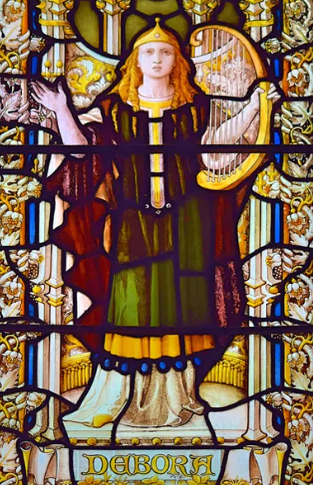
Judges 4 – After Ehud had died, the Israelites again did things that the Lord saw as evil. So the Lord gave them over to King Jabin of Canaan, who reigned in Hazor. The commander of his army was Sisera, and he was stationed in Harosheth-ha-goiim. The Israelites cried out to the Lord because Siser] had nine hundred iron chariots and had oppressed the Israelites cruelly for twenty years.
Now Deborah, a prophet, the wife of Lappidoth, was a leader of Israel at that time. She would sit under Deborah’s palm tree between Ramah and Bethel in the Ephraim highlands, and the Israelites would come to her to settle disputes. She sent word to Barak, Abinoam’s son, from Kedesh in Naphtali and said to him, “Hasn’t the Lord, Israel’s God, issued you a command? ‘Go and assemble at Mount Tabor, taking ten thousand men from the people of Naphtali and Zebulun with you. I’ll lure Sisera, the commander of Jabin’s army, to assemble with his chariots and troops against you at the Kishon River, and then I’ll help you overpower him.’”
Barak replied to her, “If you’ll go with me, I’ll go; but if not, I won’t go.”
Deborah answered, “I’ll definitely go with you. However, the path you’re taking won’t bring honor to you, because the Lord will hand over Sisera to a woman.” Then Deborah got up and went with Barak to Kedesh. He summoned Zebulun and Naphtali to Kedesh, and ten thousand men marched out behind him. Deborah marched out with him too.
Now Heber the Kenite had moved away from the other Kenites, the descendants of Hobab, Moses’ father-in-law, and had settled as far away as Elon-bezaanannim, which is near Kedesh.
When it was reported to Sisera that Barak, Abinoam’s son, had marched up to Mount Tabor, Sisera summoned all of his nine hundred iron chariots and all of the soldiers who were with him from Harosheth-ha-goiim to the Kishon River. Then Deborah said to Barak, “Get up! This is the day that the Lord has handed Sisera over to you. Hasn’t the Lord gone out before you?” So Barak went down from Mount Tabor with ten thousand men behind him. The Lord threw Sisera and all the chariots and army into a panic before Barak; Sisera himself got down from his chariot and fled on foot. Barak pursued the chariots and the army all the way back to Harosheth-ha-goiim, killing Sisera’s entire army with the sword. No one survived.
Meanwhile, Sisera had fled on foot to the tent of Jael, the wife of Heber the Kenite, because there was peace between Hazor’s King Jabin and the family of Heber the Kenite. Jael went out to meet Sisera and said to him, “Come in, sir, come in here. Don’t be afraid.” So he went with her into the tent, and she hid him under a blanket.
Sisera said to her, “Please give me a little water to drink. I’m thirsty.” So she opened a jug of milk, gave him a drink, and hid him again. Then he said to her, “Stand at the entrance to the tent. That way, if someone comes and asks you, ‘Is there a man here?’ you can say, ‘No.’”
But Jael, Heber’s wife, picked up a tent stake and a hammer. While Sisera was sound asleep from exhaustion, she tiptoed to him. She drove the stake through his head and down into the ground, and he died. Just then, Barak arrived after chasing Sisera. Jael went out to meet him and said, “Come and I’ll show you the man you’re after.” So he went in with her, and there was Sisera, lying dead, with the stake through his head.
So on that day God brought down Canaan’s King Jabin before the Israelites. And the power of the Israelites grew greater and greater over Canaan’s King Jabin until they defeated him completely.
First, a textual note. Deborah is introduced to us as the “wife of Lappidoth.” There are scholars that have argued that this is a mistranslation. They say that the accurate translation is “woman of torches,” which was to suggest that she was known as a “fiery woman.” I am inclined to side with this translation because her husband, if she had one, is mentioned nowhere else in scripture and even more compelling is that the story of Deborah is a story of a “fiery woman.”
She must have been. She lived during an extremely patriarchal time when women were not ever “leaders of men.” Yet she is revered as a prophet and a judge. That puts her in the company of only two other biblical heroes – Moses and Samuel. I try to think about what it must have taken for the entire people of Israel to give assent to being led by a woman for forty years. How remarkable must Deborah have been for men to put aside their cultural biases and assumptions and give their assent to her leadership and wisdom. As I ponder this, I can only believe that the people (men and women) were so thoroughly convinced that Deborah’s role among the community was anointed and commissioned by God that they had to lay aside all they had assumed before that point. They must have been convinced that Deborah was God’s way of delivering them from King Jabin of the Canaanites.
Stay with that thought for a while today – the idea that sometimes, we have to let go of notions we have held all our lives in order to embrace what God is doing now. To the extent that we are able to do that, we too can be delivered from our past.
Question: Is there any long-held idea in your mind that, as you look at what God is doing in these days, you feel prompted to rethink for the sake of embracing the way in which God is moving?
Prayer: Eternal God, thank for the witness of the great prophet and judge Deborah. Use her story to shape ours as we seek to be open to what You are doing in our own time.
Prayer Focus: Pray for God to bless leaders you know of today who you would not normally pray for.
Song: Free Your Mind – En Vogue (I couldn’t not use this song about prejudice from some other “fiery women”)
 Weekday Word w/ Eric
Leave a comment