
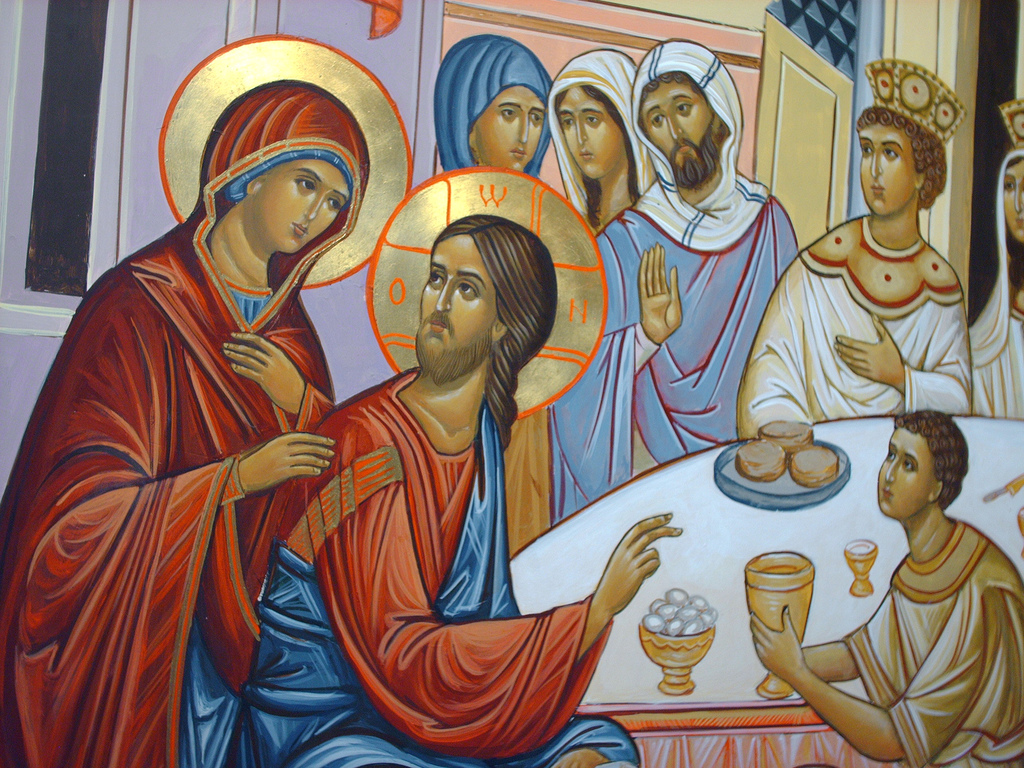
John 2:1-12, CEB
On the third day there was a wedding in Cana of Galilee. Jesus’ mother was there, and Jesus and his disciples were also invited to the celebration. When the wine ran out, Jesus’ mother said to him, “They don’t have any wine.”
Jesus replied, “Woman, what does that have to do with me? My time hasn’t come yet.”
His mother told the servants, “Do whatever he tells you.” Nearby were six stone water jars used for the Jewish cleansing ritual, each able to hold about twenty or thirty gallons.
Jesus said to the servants, “Fill the jars with water,” and they filled them to the brim. Then he told them, “Now draw some from them and take it to the headwaiter,” and they did. The headwaiter tasted the water that had become wine. He didn’t know where it came from, though the servants who had drawn the water knew.
The headwaiter called the groom and said, “Everyone serves the good wine first. They bring out the second-rate wine only when the guests are drinking freely. You kept the good wine until now.” This was the first miraculous sign that Jesus did in Cana of Galilee. He revealed his glory, and his disciples believed in him.
After this, Jesus and his mother, his brothers, and his disciples went down to Capernaum and stayed there for a few days.
When we consider that Jesus’s disciples were with Him for nearly three years, we can assume that the stories they could tell about His ministry could fill at least a dozen books that are gospel-sized. Because of this, we can assume that the stories the gospel writers do tell hold special significance. Perhaps this is even more true for the Gospel of John, for the gospel itself often gives hints to special significance.
This story above performs at least a couple of revelatory functions. First, fresh out of the wilderness with John the Baptist, Jesus takes his disciples to a wedding. Jewish weddings are a considered a sign of the joy and reign of God. Jesus’s appearance at one signifies His participation in that joyous reign. We are meant to notice the transition from John’s ascetic warnings and calls to repent to Jesus’s participation in the joy of the people.
The joy is interrupted (for people behind the scenes) by the host running out of wine. Jesus’s mother asks Jesus to do something about it. In addition to knowing Jesus could solve this rather minor problem easily, it also seems to suggest that Jesus’s mother wants others to know that too. “Show your glory, son,” she seems to be saying.
She seems to be saying that because Jesus’s answer seems aimed at telling her that it’s not time for public glory. Further, His mother takes direction from her son and Lord and then instructs the servants to do what Jesus says. “Ok Jesus, we’ll keep it quiet for now,” is the implication. Only the servants and Jesus’s disciples will know. But because this story was chosen for the Gospel, we’ll know too. The only thing the public crowd will know is that the best wine was served last.
Another detail that is important to notice is in Jesus’s instructions to the servants. He tells them to fill the stone jars with water. This would have been something the servants would have done before, but this time the purpose will change. The jars normally are used for purification rites, much like baptism is Hebrew tradition before Jesus. But now, these jars will serve wine that was previously water – wine with which the guests will be quite pleased. We know that wine will eventually signify something much more profound. The disciples get the first hint of that here in this story. This is the first of seven signs found in John that reveal the nature of the glory of Jesus. But at this point in the story, only a few people are privy to it’s revelation. Jesus chose to do so and that is an important Johnanine truth as well; revelation is always God’s choice.
Question: How would you describe Jesus’s glory?
Prayer: Jesus, we are so grateful to be granted revelation of who You are and what you have done. Lead us to be good stewards of this gift. Amen,
Prayer Focus: Pray for the marriages of couples you know about who are engaged or newly married.
Song: Matthew West – When I Say I Do
 Weekday Word w/ Eric
Leave a comment