
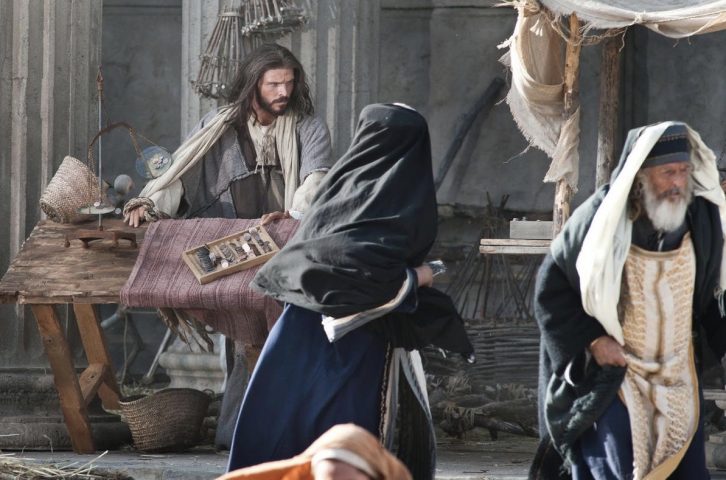
John 2:13-22
It was nearly time for the Jewish Passover, and Jesus went up to Jerusalem. He found in the temple those who were selling cattle, sheep, and doves, as well as those involved in exchanging currency sitting there. He made a whip from ropes and chased them all out of the temple, including the cattle and the sheep. He scattered the coins and overturned the tables of those who exchanged currency. He said to the dove sellers, “Get these things out of here! Don’t make my Father’s house a place of business.” His disciples remembered that it is written, Passion for your house consumes me.
Then the Jewish leaders asked him, “By what authority are you doing these things? What miraculous sign will you show us?”
Jesus answered, “Destroy this temple and in three days I’ll raise it up.”
The Jewish leaders replied, “It took forty-six years to build this temple, and you will raise it up in three days?” But the temple Jesus was talking about was his body. After he was raised from the dead, his disciples remembered what he had said, and they believed the scripture and the word that Jesus had spoken.
When reading Matthew, Mark, and Luke, you will notice that what has come to known as the cleansing of the Temple, comes at the end of Jesus’s ministry. In those gospels, it serves to set in motion the chain of events that end with Jesus’s crucifixion and subsequent resurrection. Here in John though, this event is set as the launching of Jesus’s public ministry. It seems obvious that both chronologies cannot be correct. However, we need to remind ourselves that the gospel writers weren’t primarily trying to get the chronology right; they were trying to illuminate the truth of the life of Jesus to which they were witnesses. Organizing the events to illumine that truth was more important than putting the events in order. This priority is shared by other writers of their era. It is much later that human writers develop a commitment to linear history.
Because of this, we should focus our attention on why the gospel writers position events as they do. Specifically, we should ask ourselves why John begins telling the story of Jesus’s public ministry with the dramatic confrontation with the religious establishment of his day. In the other gospels, this conflict develops slowly over time and reaches a climax at the beginning of “holy week.” For John, it is important to see that the conflict is not only full-blown from the beginning, but it is tied to the very reason Jesus came.
No one who was present that day realized this until after Jesus was resurrected three years later. This includes the author of John. John, many years after the resurrection, is now trying to give us the benefit of hindsight in the way he tells the story. Jesus came, in large part, to replace the entire religious system! Seen in this way, Jesus’s answer to the Jewish leaders questioning of His authority takes on new significance:
“Destroy this temple and in three days I’ll raise it up.”
Another way to translate this statement is, “destroy this Temple, and in three days I’ll replace it.” The other gospels certainly allude to shifting of the center of worship from the Temple to Jesus himself, but John makes it very clear that this is God’s intention in the Word becoming flesh. This not about confronting a corrupt sacrificial system as it is in the other three gospels. This is about replacing the sacrificial system altogether. This point will be reaffirmed at multiple points throughout John, but we are meant to notice it right here in chapter 2.
What we today can infer from this is that God’s intention has not changed in the two thousand years since Jesus’s resurrection. To the extent that religious practices and systems become primarily about anything but the worship of Jesus and the carrying out of Jesus’s ministry, God’s desire is that they be completely replaced. As Jesus said back then, He would still say today, “don’t make my Father’s house a place of business.” The church is not to be a business. Unfortunately, two millennia after Jesus said it the first time, it still must be said now.
Question: What practices of churches of which you are familiar would draw Jesus’s confrontation today?
Prayer: O Lord of All, how quickly we humans take Your divine purposes and put our earthly spin on them for our own purposes. Please forgive us and help us to return to “zeal for Your House.” Amen.
Prayer Focus: Pray for churches and other Christian organizations that are facing scandals.
Song: Speak O Lord – Shane and Shane
 Weekday Word w/ Eric
Leave a comment