
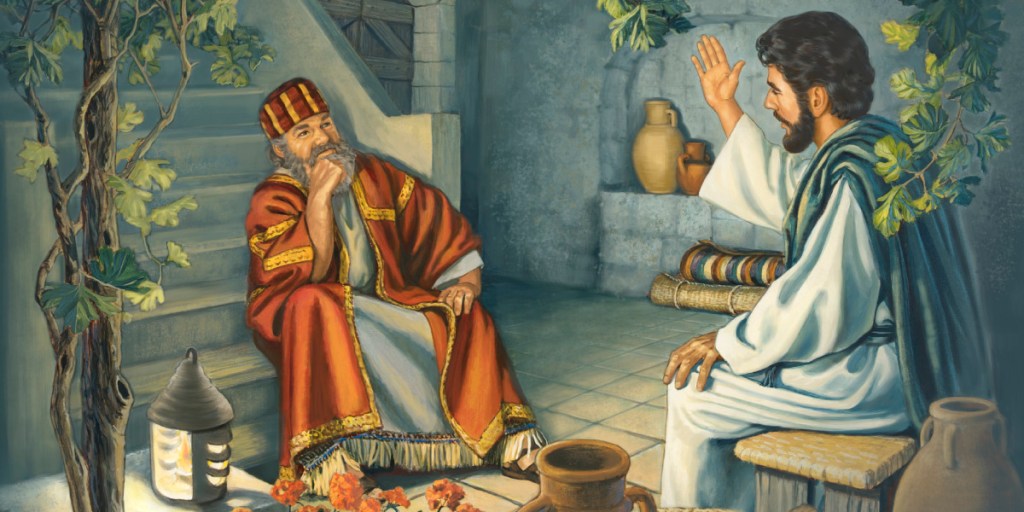
John 3:1-10
There was a Pharisee named Nicodemus, a Jewish leader. He came to Jesus at night and said to him, “Rabbi, we know that you are a teacher who has come from God, for no one could do these miraculous signs that you do unless God is with him.”
Jesus answered, “I assure you, unless someone is born anew, it’s not possible to see God’s kingdom.”
Nicodemus asked, “How is it possible for an adult to be born? It’s impossible to enter the mother’s womb for a second time and be born, isn’t it?”
Jesus answered, “I assure you, unless someone is born of water and the Spirit, it’s not possible to enter God’s kingdom. Whatever is born of the flesh is flesh, and whatever is born of the Spirit is spirit. Don’t be surprised that I said to you, ‘You must be born anew.’ God’s Spirit blows wherever it wishes. You hear its sound, but you don’t know where it comes from or where it is going. It’s the same with everyone who is born of the Spirit.”
Nicodemus said, “How are these things possible?”
I grew up in a time when the term “born again” was used as a quasi-political term that carried a lot baggage. President Jimmy Carter self-described himself with that label prompting polarizing results. Because of that, my teenage friends and I avoided describing ourselves that way even though we were proud to be called Christians. M guess is that many come to this story from which that term originates with some baggage. It would be helpful to drop that baggage before proceeding further. We’re going to take two reflections to unpack this rich encounter between Jesus and the pharisee Nicodemus because there is much to notice.
First, Nicodemus comes to Jesus at night. This is understandable because the Pharisees are not sure what to do with Jesus at this point because Jesus has a considerable following, but he has also just made trouble in the Temple. Talking to Jesus under the cover of darkness seems appropriate so as not to express public approval or disapproval of Jesus at this point. It allows Nicodemus and the rest of the Jewish leaders to remain neutral for now.
But there is another function of nighttime in John’s account here. For those that have read John before (warning: spoiler alert), Nicodemus eventually embraces Jesus as the Messiah. However, that has not happened yet and because that has happened yet, Nicodemus currently is a member of the “people in darkness.” John including the detail that this encounter happened at night highlights Nicodemus’s starting point of in the darkness. In this sense, we are all Nicodemus when it comes to Jesus; we all start out in darkness.
In this reflection, we also need to unpack that “born anew” term. If you are one that reads multiple translations of scripture, you will notice that this word translated in the CEB above is “born anew,” but other translations render it “born from above.” This is because the Greek word John uses here can mean both. So every translation committee has to make a decision about which translation to use. But here’s my quick take. I believe John wanted us to hear both translations at the same time. Heard this way, Jesus is saying we must be both “born anew” and “born from above.” For now, I’m we’re going to leave that there, but I encourage you to let that thought stay with you as we work our way through the gospel.
If you accept my conviction about the double meaning intended by John that we just discussed, then you will probably be quick to accept that John does it again here in this same passage. In verse 8, Jesus says this:
God’s Spirit blows wherever it wishes. You hear its sound, but you don’t know where it comes from or where it is going. It’s the same with everyone who is born of the Spirit.”
The word “spirit” is another Greek word with two possible meanings. Most translations choose “spirit,” but some choose the other meaning “wind.” I would encourage you to hear both “wind and Spirit.”
These ambiguities are purposeful for the development of unique Johannine ideas. They allow us to see the mystery in the invitation of Jesus. The invitation extended to Nicodemus is also extended to us, but it’s hard nail down concretely. It’s a little like being born anew. It’s also a little like embracing a birth that comes from above (meaning coming from God). It’s also a little like noticing the wind but not being sure where it came from or where it’s headed. God’s “wind” is just as unpredictable as the wind we feel blowing across our face.
No wonder Nicodemus cries out at this point, “how are these things possible?” We’ll hear Jesus’s answer next time, but for now, consider these questions.
Questions: How would you use “birth” language to describe your journey with Jesus? Are you able to “nail down” your faith in unambiguous terms? Why or why not?
Prayer: God, you are divine and we are not. Our wisdom is your foolishness and your wisdom often seems like foolishness to us. We cry our like Nicodemus, “how are these things possible?” Teach us your wisdom nonetheless. Amen.
Prayer Focus: Pray for people struggling with big life questions today.
Song: Winds of Glory – New Wine
 Weekday Word w/ Eric
Leave a comment