
John 4:4-15, CEB
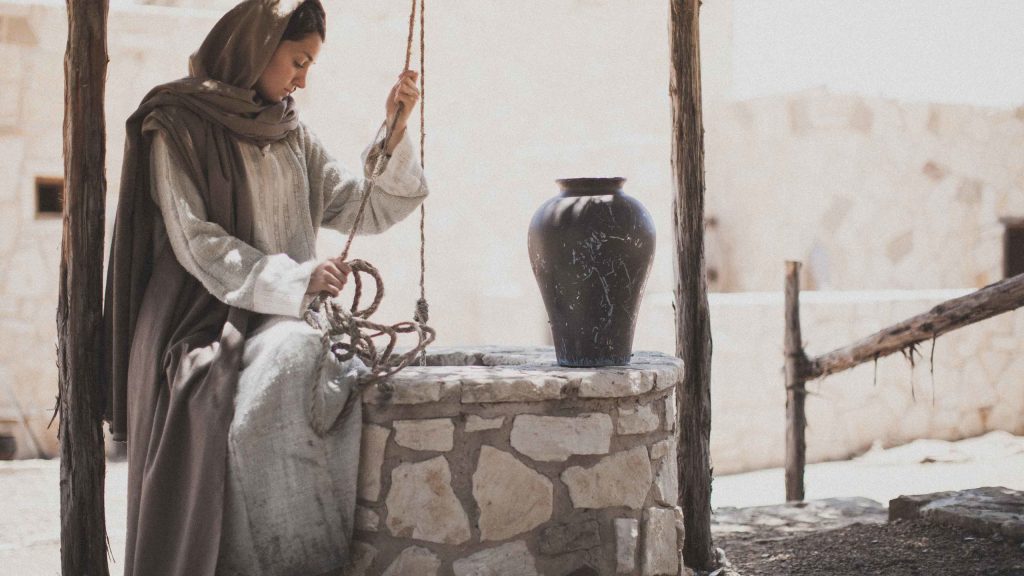
Jesus had to go through Samaria. He came to a Samaritan city called Sychar, which was near the land Jacob had given to his son Joseph. Jacob’s well was there. Jesus was tired from his journey, so he sat down at the well. It was about noon.
A Samaritan woman came to the well to draw water. Jesus said to her, “Give me some water to drink.” His disciples had gone into the city to buy him some food.
The Samaritan woman asked, “Why do you, a Jewish man, ask for something to drink from me, a Samaritan woman?” (Jews and Samaritans didn’t associate with each other.)
Jesus responded, “If you recognized God’s gift and who is saying to you, ‘Give me some water to drink,’ you would be asking him and he would give you living water.”
The woman said to him, “Sir, you don’t have a bucket and the well is deep. Where would you get this living water? You aren’t greater than our father Jacob, are you? He gave this well to us, and he drank from it himself, as did his sons and his livestock.”
Jesus answered, “Everyone who drinks this water will be thirsty again, but whoever drinks from the water that I will give will never be thirsty again. The water that I give will become in those who drink it a spring of water that bubbles up into eternal life.”
The woman said to him, “Sir, give me this water, so that I will never be thirsty and will never need to come here to draw water!”
Last time, I suggested Jesus, by choosing a non-traditional route to Galilee through Samaria, had an intention to keep an “appointment.” In this reflection, we see with whom Jesus intends to meet, even though the person in question has no idea about the encounter about to take place. As Jesus and his entourage approach the Samaritan city of Sychar, they stop at Jacob’s well (a detail we should not miss, but more on that later). The disciples go into town to secure supplies, but Jesus remains at the well. A Samaritan woman arrives at this moment and sets the stage for a conversation that frames the theological assertion of much of the rest of the gospel. We will take a few reflections to work our way through all the layers of meaning.
Jesus begins the encounter by breaking at least two traditions. The woman shows her awareness of these violations by ignoring His request and asking her own question. A Jewish man would not engage in a conversation with an unknown woman and that same Jewish man certainly would not ask a Samaritan for water. Had Jesus not spoken first, there probably would be no conversation, because the woman, following her own traditions, would not have spoken to a Jew. But since this man speaking to her obviously is not aware of the violations, she calls them out.
Jesus abandons his initial ask for water and takes the woman’s lead. However, he pushes the conversation beyond her question. Jesus asserts that something is going here that she is not yet aware. In this encounter, there is the possibility that the woman could receive a gift even though it was Jesus that made the original request. She could receive “living water.”
Like Nicodemus before her, the woman takes Jesus’s words too literally. She still thinks this is about simple water. However, she shows some theological chops by bringing Jacob into the conversation. When she heard the term “living water,” she rightly heard that the water Jesus was offering was better than the well water she was about to draw from Jacob’s ancient well. The words translated “living water” can refer to fresh spring water from a pure deep underground source. The woman knew from living her whole life in that area that no such spring existed anywhere near where they were currently standing. Otherwise, Jacob would have found it. This is why the woman brings the towering figure of Jacob into the conversation with a cheeky question, “are you greater than our father Jacob?” I say cheeky question because she has already concluded that the answer to her question was “no;” This man before her is not greater than Jacob. Her question is actually more of a challenge than an actual question. It parallels Nicodemus’s “how can this be?”
However, Jesus doesn’t get defensive. He simply continues to move the conversation ever deeper. He suggests the “water” they are now talking about is not simply pure spring water. When one accepts the aforementioned gift, they will “never be thirsty again.” It is at this point that the woman’s attitude toward Jesus shifts abruptly. It is clear that she now believes Jesus is offering her something miraculous, even though she still misunderstands the full nature of the miracle. She goes where Jesus had invited her to go – to ask for what He’s offering:
“Sir, give me this water, so that I will never be thirsty and will never need to come here to draw water!”
What the author of John would have us notice at this point is that this unnamed Samaritan woman has, in a one minute conversation with Jesus, moved further toward the Truth than the learned teacher of the Jewish faith Nicodemus did in his first conversation with Jesus. Her theological assumptions certainly impeded her receptivity to Jesus just as they did with Nicodemus, but she is able to let go of them in order to embrace something she still doesn’t quite understand where Nicodemus remained blocked. The gospel invites us to do the same.
Question: How open are you to the possibility that Jesus offers you more than you than you thought you understood up until this point?
Prayer: Lord, you do not desire us to have a stagnant faith any more than you want us to drink stagnant water. Help us be open and attentive to where you are inviting us to go right now.
Prayer Focus: Have a conversation with God today about some aspect of your faith that you seem a bit uncertain about now.
Song: Living Water – Shane & Shane
 Weekday Word w/ Eric
Leave a comment