
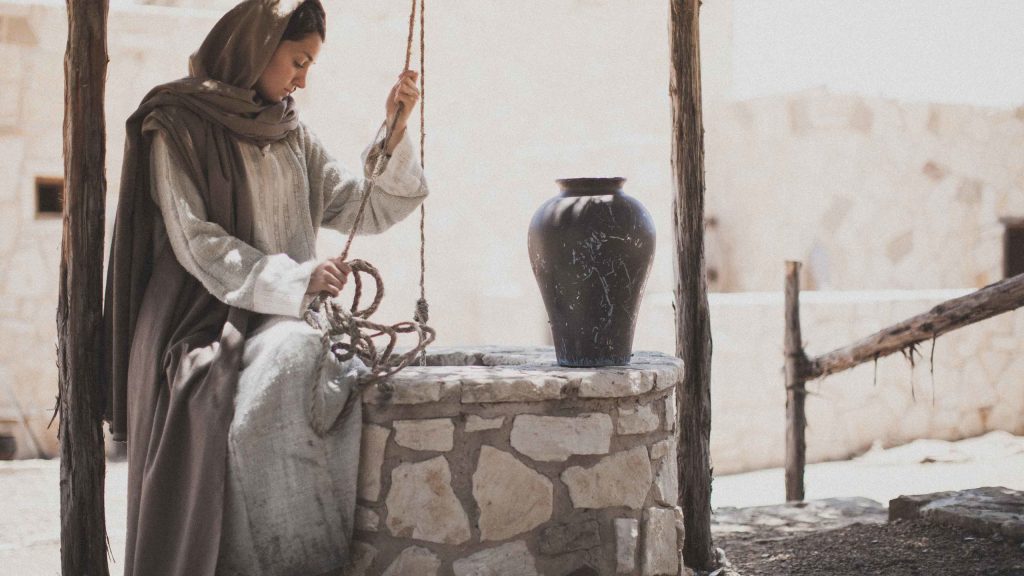
John 4:19-24, CEB
The woman said, “Sir, I see that you are a prophet. Our ancestors worshipped on this mountain, but you and your people say that it is necessary to worship in Jerusalem.”
Jesus said to her, “Believe me, woman, the time is coming when you and your people will worship the Father neither on this mountain nor in Jerusalem. You and your people worship what you don’t know; we worship what we know because salvation is from the Jews. But the time is coming—and is here!—when true worshippers will worship in spirit and truth. The Father looks for those who worship him this way. God is spirit, and it is necessary to worship God in spirit and truth.”
It might be helpful to go back and read this conversation from the beginning (4:7) to get a sense of the flow of the conversation again. When you do that, you might notice that the conversation could have ended a couple of times by now. The woman could have gotten Jesus some water when he asked. Instead, she pursues his break with multiple traditions by even speaking to her. At a couple of points after this, the woman could have simply written Jesus off as a little crazy – His talk of living water when they are currently at the only well for miles and again when He suggested that the water he has talking about would quench thirst indefinitely. She also could have shut Jesus down when He brought her “husband” into it. However, through all of this, she continues to engage Jesus and follow her curiosity about what Jesus was saying. It certainly speaks to the presumption that Jesus’s non-verbal communication while this conversation progresses was hospitable and inviting despite being at the same time challenging and even a bit confrontive. However, it says a lot about this woman who displays remarkable poise and keeps coming back at Jesus with new questions.
At this point in our reflections on this encounter, Jesus has just revealed that He is somehow aware of the woman’s current lack of a husband as well as her entire unfortunate marital history. As we just pointed out, instead of putting her off, this revelation from Jesus simply prompts her to pursue the conversation further. She concludes Jesus, in order to have such private knowledge, must be a prophet and she tells Jesus that in preface to her next challenge. And that next query is a monumental one – a dividing line between the Jews and the Samaritans. Samaritans practiced a mixed religion where the God of the Jews was worshipped alongside the cultic Gods of the Assyrians and others. The geographic center of this hybrid faith is Mount Gerizim. This is why Jesus asserts that Samaritans “worship what they don’t know.” The Jews, of course, are purely monotheistic and the center is Jerusalem. These differences have persisted for many generations to the point where it is likely that most Jews and Samaritans have inherited the disdain for each other without fully understanding the root of the schism. The woman at the well raising the dispute of the geographical center of worship seems to be aimed at asking this “prophet” if He can shed any light on that dispute. Once again, this is a clear sign that the woman is very theologically astute.
Though Jesus does, with one off-handed phrase, condemn the Samaritans’ religious pluralism, he does so only to include the Jews in their misguidedness as well. The true center of worship has nothing to do with geography. Holy ground is wherever God is, and God cannot not be confined to any designated space. Once again, the conversation could have ended here, but the woman continues to go deeper with Jesus. We will start with that next time, but right now, let’s focus on the human tendency to fixate upon geography.
It is natural to become attached to places where you (or even your ancestors) had significant spiritual experiences. The association between the experience (and all the feelings conjured by the memory of the experience) and the place where the experience can become so strong that it is hard for even the most rational human beings separate in their mind and heart. The place IS the experience after time has passed. We see this throughout the Old and New Testaments and our Christian history since the scriptures were compiled into what we know as the Bible. Humans often confuse separation from physical places with becoming disconnected from the experiences of God that have been associated with those spaces. As a pastor who has served a handful of congregations who have had to experience this physical separation, I have seen this confusion up close.
Jesus points this woman to a time when we no longer need to rely on these physical connections. We, the heirs of those who received this incredible gift of God’s presence, now live in that time Jesus is pointing to in this text. The God we “visit” in “sacred” spaces has moved into our space in a way that transcends geography. Where we are, God is. While sacred spaces still serve a purpose in our faith, they are not essential.
Question: If the specific “sacred places” that have come to be a constant in your faith life were suddenly gone and never return, what would it do to your faith?
Prayer: God, while we are thankful for sanctuaries, church camps, and other significant spaces where we have met you in the past, help us never to confine You to those spaces. We truly do want to worship You in spirit and truth. Amen.
Prayer Focus: Pray for people whose churches have closed recently.
Song: Spirit & Truth – Chris Sayburn
 Weekday Word w/ Eric
Leave a comment