
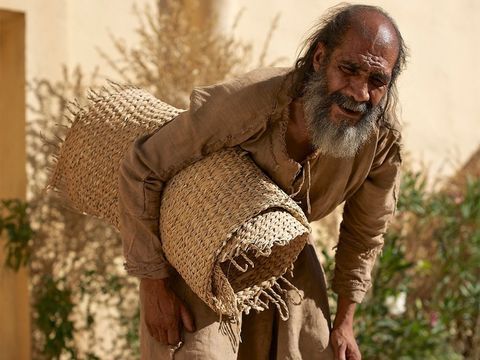
John 5:10-18, CEB
The Jewish leaders said to the man who had been healed, “It’s the Sabbath; you aren’t allowed to carry your mat.”
He answered, “The man who made me well said to me, ‘Pick up your mat and walk.’”
They inquired, “Who is this man who said to you, ‘Pick it up and walk’?” The man who had been cured didn’t know who it was, because Jesus had slipped away from the crowd gathered there.
Later Jesus found him in the temple and said, “See! You have been made well. Don’t sin anymore in case something worse happens to you.” The man went and proclaimed to the Jewish leaders that Jesus was the man who had made him well.
As a result, the Jewish leaders were harassing Jesus, since he had done these things on the Sabbath. Jesus replied, “My Father is still working, and I am working too.” For this reason the Jewish leaders wanted even more to kill him—not only because he was doing away with the Sabbath but also because he called God his own Father, thereby making himself equal with God.
I have seven years of post-secondary education in the area of religion. I have a degree that says I am a “Master of Divinity.” While I am more than a little uncomfortable with that title, I do have to admit that those extra years of education sometimes cause me to place more than appropriate confidence in my “rightness” on theological issues. This is especially true when I perceive myself to be in, as some say, “a battle of wits with an unarmed person.” I confess this to show that I believe that I understand the mindset of the religious leaders in this story. When I believe that I am “the expert” in the conversation, I listen less to understand and more to correct. I ignore details that don’t seem relevant to the point I’m trying to make. And, to be honest, I become invested in making sure that everyone involved knows that I’m right.
The religious leaders in this story see one thing – the sabbath has been broken. The sabbath was not just a law, but one of the Big Ten. To add insult to injury, Jesus makes the claim that He is the Son of God. He claimed it indirectly, but He made the claim nonetheless. From the perspective of the religious leaders, that is breaking another of the Ten Big laws (The 10 Commandments just to be clear). Conscientious religious leaders cannot ignore the fact that the law is being broken.
The problem here is that, in coming to the conclusion that important laws have been broken (and they, as religious leaders are charged with uploading the laws), the leaders have ignored some pretty significant details that are in conflict with their conclusion. First, a man who has been sick for 38 years has been healed by someone who claims to represent their God. If this is a healing that has accomplished by God’s power and authority, the leaders’ should at the very least be paying more attention to a display of God’s miraculous power than the fact that a mat is being carried on the Sabbath. This is similar to the sentiment expressed by Jesus in Matthew 23:24, when he is quoted, “Matthew 23:24, Jesus criticizes religious leaders, saying “You blind guides! You strain out a gnat, but swallow a camel.” The other issue that the leaders are ignoring is the possibility that they are actually talking to the Son of God. After all, an “unhealable man” has just been healed. It seems to be prudent to at least do some more investigation. But convinced they are right and ignoring anything that might speak to the contrary, they begin to seek a way to kill the Healer.
You and I are not immune to making the same kinds of mistakes. God often operates outside of our conception of “the rules” about how God works. Our need to be right sometimes blinds us to evidence to the contrary. The only guard against this genuine humility – the idea that, at any given moment, God can do anything God wants whether it fits into our previously held convictions about what God will or won’t do.
My experience has been that God regularly breaks “my” rules. Praise be to God! Fortunately, up until this point, I have always been able to “catch up” with God by rethinking my rules and leaving my faulty assumptions behind. To be clear, this has always meant that I had to admit that I was wrong, sometimes even about very important things. I expect that this same humbling will happen to me again . . . and again. . .and again. It’s part and parcel to being human and not being God.
Question: Have you ever had the sneaking suspicion that some opinion or conviction you have held for a time might be wrong?
Prayer: God, my wisdom is sometimes Your foolishness and my foolishness is sometimes Your wisdom. Help me to see the times when I need to “catch up” with You. Amen.
Prayer Focus: Pray for the students (at all levels of formal education) that you know today.
Song: You are Giod and I am Not – The Wilbanks
 Weekday Word w/ Eric
Leave a comment