
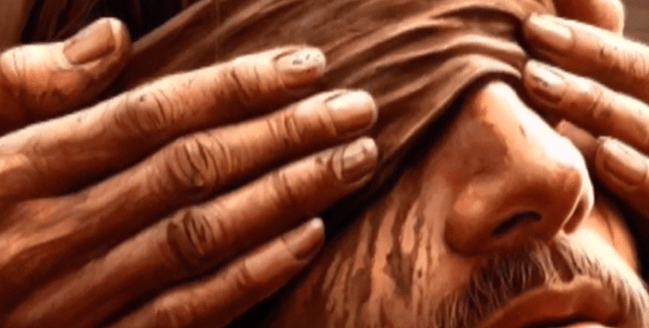
John 9:8-17, CEB
The man’s neighbors and those who used to see him when he was a beggar said, “Isn’t this the man who used to sit and beg?”
Some said, “It is,” and others said, “No, it’s someone who looks like him.”
But the man said, “Yes, it’s me!”
So they asked him, “How are you now able to see?”
He answered, “The man they call Jesus made mud, smeared it on my eyes, and said, ‘Go to the pool of Siloam and wash.’ So I went and washed, and then I could see.”
They asked, “Where is this man?”
He replied, “I don’t know.”
Then they led the man who had been born blind to the Pharisees. Now Jesus made the mud and smeared it on the man’s eyes on a Sabbath day. So Pharisees also asked him how he was able to see.
The man told them, “He put mud on my eyes, I washed, and now I see.”
Some Pharisees said, “This man isn’t from God, because he breaks the Sabbath law.” Others said, “How can a sinner do miraculous signs like these?” So they were divided. Some of the Pharisees questioned the man who had been born blind again: “What do you have to say about him, since he healed your eyes?”
He replied, “He’s a prophet.
In this next part of the story, we hear the man whose sight was restored by Jesus speak for the first time. He confirms to people he has known for a long time that he is indeed the man who was blind. He reports what Jesus did in literal fashion, though he did not know Jesus’ name at this point. When he done what Jesus had asked, he could see. The people who heard the report take him to the Pharisees, which was customary. Pharisees would officially confirm miracles.
Only it is clear the Pharisees aren’t very interested in confirming this miracle. They were already determined to discredit Jesus and the fact that Jesus performs this miracle on a sabbath provides a potential opportunity to do that. Healing would be considered work and no work is to be done on the sabbath.
There are two details concerning the Pharisees that are important. First, they are actually divided on the issue of Jesus. Some of them seem only to see that Jesus ignored Sabbath law and so he must be condemned. But others actually wonder how a law-breaker can heal. So they ask the man who had been healed about his thoughts about Jesus. The man believes Jesus is a prophet and he says so – not what the Pharisees wanted to hear. The second surprising detail concerning the Pharisees is that they do admit the miracle. This creates the sad irony of this story; a man born blind from birth receives his sight and the Pharisees are looking to discredit the healer because the healing was done on the sabbath. No more comment on the Pharisees is needed at this point.
At this point in the story, John is trying to show us that this story is about more that physical blindness. There is a spiritual blindness that is even more serious and the tragedy is that is self-imposed. We will say more about this as the story unfolds, but for now, think about these questions.
Questions: Have you ever found yourself to miss something amazing because you were looking for something else at the time? Have you ever been wrong about your assessment of someone because your assessment was closed too early?
Prayer: Lord, we confess that our preconceptions sometimes blind us to what is really happening right in front of us. Remove the mud from our eyes so that we may see Your work clearly. Amen.
Prayer Focus: Pray people you know who are resistant to the church today. \
Song: Once Blind – Echoes of the Sacred
 Weekday Word w/ Eric
Leave a comment